Date: Sep 24, 2026 Day: Thursday
Becoming a doctor requires much more than learning medical theory from textbooks. Medical students need to understand diseases, but they also need to learn how to communicate with patients, perform examinations, respond to emergencies, analyse clinical situations, and carry out medical procedures safely.
This is where simulation-based education plays an important role.
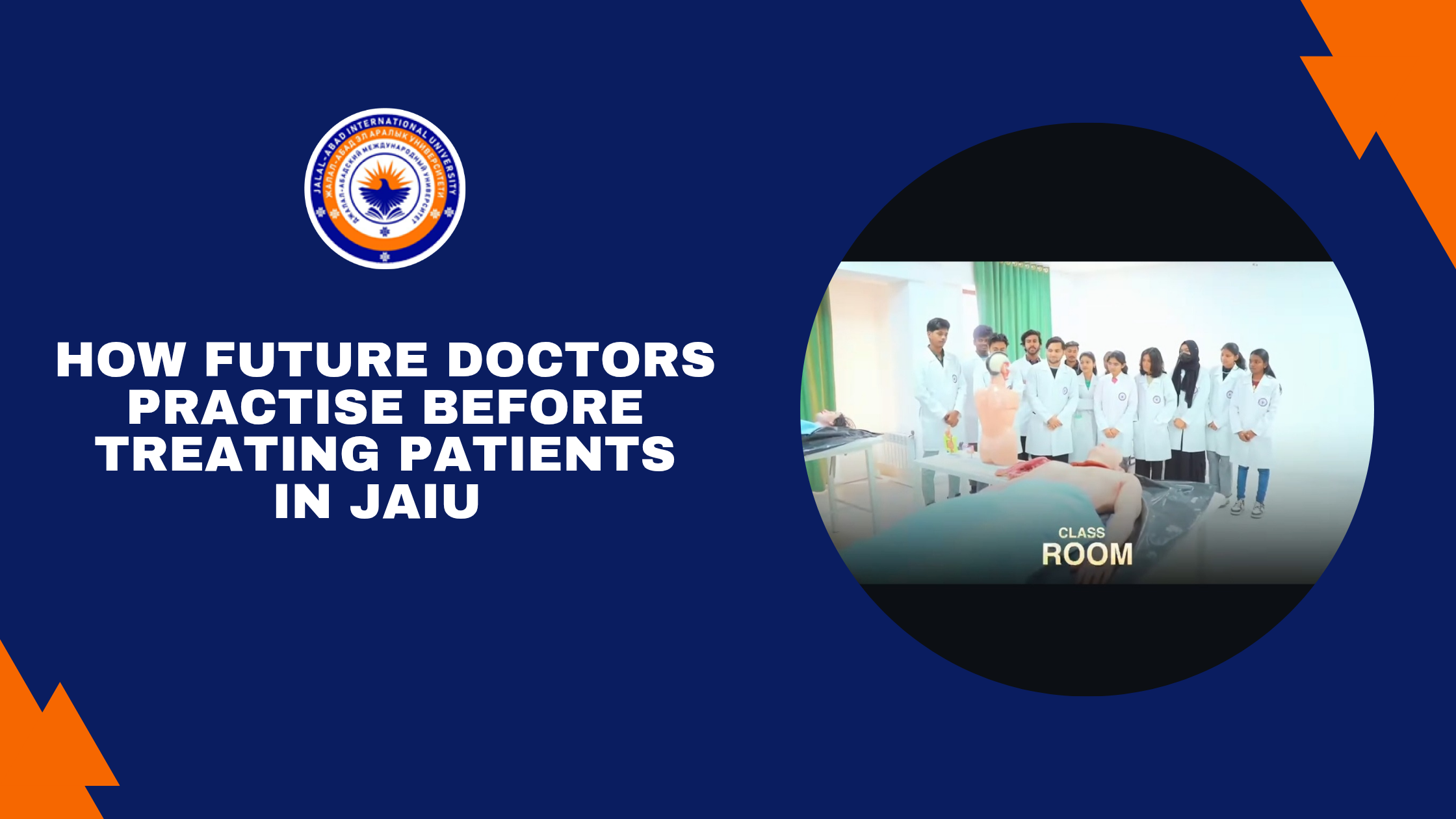
At Jalal-Abad International University (JAIU), the Simulation Center is an important part of practical medical education. It provides students with a controlled environment where they can practise clinical skills before performing them with real patients. The university describes the center as a foundation for practical training as well as Objective Structured Clinical Examination (OSCE) and Objective Structured Practical Examination (OSPE).
A medical simulation center is a learning environment designed to recreate clinical situations without putting real patients at risk.
Instead of immediately performing a procedure on a patient, students can first practise it using simulation equipment, mannequins, phantoms, standardized patients, and structured clinical scenarios.
This allows students to make mistakes, receive feedback, repeat procedures, and improve their technique under supervision.
At JAIU, simulation-based learning is integrated into the practical education of medical students. The university states that students progress from basic communication and patient-care skills in the early years toward diagnostic and therapeutic procedures and clinical case analysis in later stages.
One of the major advantages of simulation training is that students can develop their skills before entering real clinical situations.
For example, a student may need to learn how to communicate with a patient, collect medical history, perform a physical examination, or respond to an emergency situation.
Practising these skills in a controlled environment gives students an opportunity to understand the correct sequence of actions and receive guidance from instructors.
JAIU's Simulation Center is designed around this principle: students develop practical competencies in a safe setting before applying them during clinical training.
This creates a gradual learning pathway rather than expecting students to perform unfamiliar procedures immediately in a hospital.
Medical education develops progressively.
During the early stages, students need to build fundamental skills such as communication, patient interaction, basic examination techniques, and patient-care procedures.
As students advance, the level of complexity increases.
JAIU states that senior students can progress toward diagnostic and therapeutic procedures, clinical case analysis, and supervised roles such as assisting medical professionals.
This progression is important because clinical competence develops over time. A student first learns the underlying concept, then practises the skill, receives feedback, and eventually applies it in a real clinical environment under appropriate supervision.
Students are not only expected to learn clinical skills; they also need to demonstrate them.
OSCE stands for Objective Structured Clinical Examination. It is a practical assessment method in which students complete specific clinical tasks at different stations.
At JAIU, the Simulation Center serves as a foundation for OSCE examinations. The university uses structured stations to assess areas such as clinical competencies and communication skills.
Instead of assessing students only through written examinations, an OSCE can evaluate how they actually perform a clinical task.
For example, an assessment station may require a student to communicate with a standardized patient, perform a particular examination, interpret information, or demonstrate an appropriate clinical response.
This makes practical assessment an important part of medical education.
Alongside OSCE, JAIU also uses OSPE, or Objective Structured Practical Examination.
OSPE is particularly relevant to practical subjects and laboratory-based learning. JAIU's current information identifies OSPE laboratories for practical work in areas such as physiology, anatomy, and pathology.
This allows students to demonstrate practical understanding rather than relying entirely on theoretical answers.
Together, OSCE and OSPE provide different ways of assessing whether students can apply what they have learned.
Medical students also need to be prepared for situations where quick and appropriate action matters.
JAIU's clinical departments describe simulation-based training for emergency care, basic and advanced resuscitation, and various surgical and obstetric-gynecological procedures using simulators and mannequins.
Training in simulated emergency scenarios allows students to practise decision-making and teamwork without exposing real patients to inexperienced procedures.
Repeated practice can also help students understand the sequence of actions required in different clinical situations.
Medical simulation is increasingly connected with technology.
JAIU states that its Simulation Center is developing its equipment and incorporating digital simulations, as well as VR and AR elements and interactive learning formats.
Technology can make clinical education more visual and interactive. Students can encounter simulated cases, practise procedures, and receive structured feedback in an environment designed for learning.
The purpose is not to replace real clinical exposure. Instead, simulation provides another layer of preparation before and alongside supervised clinical practice.
Simulation is only one part of medical education.
After developing foundational skills, students need opportunities to apply their knowledge in real healthcare environments.
JAIU's current clinical training information states that students receive early clinical exposure and participate in clinical sessions from the second semester onward. The university lists exposure across areas including therapy, surgery, pediatrics, obstetrics and gynecology, psychiatry, emergency and urgent care.
JAIU also describes clinical training at designated healthcare facilities, where students participate under the supervision of instructors and physicians.
This creates a connection between three stages of learning: understanding the theory, practising the skill through simulation, and applying the skill in a supervised clinical environment.
One of the most valuable aspects of simulation is the opportunity to learn from mistakes.
In a real clinical environment, an incorrect action can potentially affect a patient. In a simulation setting, students can identify what went wrong, receive feedback, and repeat the process.
This can help students develop a more structured approach to clinical situations.
The goal is not to eliminate every mistake before students meet patients. Rather, simulation gives them a safe environment in which to practise and improve before taking on greater clinical responsibility.
Being a doctor is not simply about memorising symptoms and treatments.
Doctors need to collect information, identify relevant findings, consider possible diagnoses, decide what additional information is required, and determine appropriate next steps.
JAIU's clinical education model includes clinical case analysis and competency-based assessment. Its clinical departments also highlight the development of clinical thinking and communication skills through early clinical exposure.
Simulation scenarios can support this development by requiring students to respond to situations rather than simply recall information.
The ultimate purpose of practical education is to prepare students for the responsibilities of medical practice.
JAIU's quality policy describes simulation-based learning and the integration of education, research, and clinical practice as components of its educational approach.
The university also uses assessment methods including OSCE, OSPE, Mini-CEX and DOPS as part of its competency-oriented assessment framework.
These methods allow different aspects of a student's development to be evaluated, from practical procedures and communication to performance in clinical settings.
The journey from medical student to doctor does not happen in a single step. Students first develop their theoretical understanding, then practise essential skills, receive feedback, and gradually move into supervised clinical environments.
At Jalal-Abad International University, the Simulation Center provides an important bridge between classroom learning and real clinical practice. Through simulation equipment, mannequins, standardized patients, OSCE and OSPE stations, students have opportunities to practise and demonstrate clinical competencies before and alongside working with real patients.
For future doctors, this combination of theory, simulation, assessment, and supervised clinical exposure can make medical education more practical and structured.
The objective is simple: learn the knowledge, practise the skill, understand the clinical situation, and then apply it responsibly in patient care.
All Blog Posts

 Happy World Teachers’ Day: Celebrating the Educators Who Shape the Future of Medicine
JAIU & Gen Z: Shaping the Future of Medical Education and Tomorrow’s Doctors
A New Journey Begins: JAIU Welcomes the Second Batch of Medical Students in Manas
JAIU in 2026: What the New Generation of Medical Students Really Wants
Jalal-Abad International University Participates in the Third Russian-Kyrgyz Educational Forum