Date: Sep 25, 2026 Day: Friday
Medical education is not only about remembering facts. A good doctor must be able to collect information, identify important symptoms, connect them with possible conditions, evaluate evidence, and decide what should happen next.
This process is often described as clinical thinking or clinical reasoning. It develops gradually through education, practical experience, discussion, observation, and repeated exposure to different medical situations.
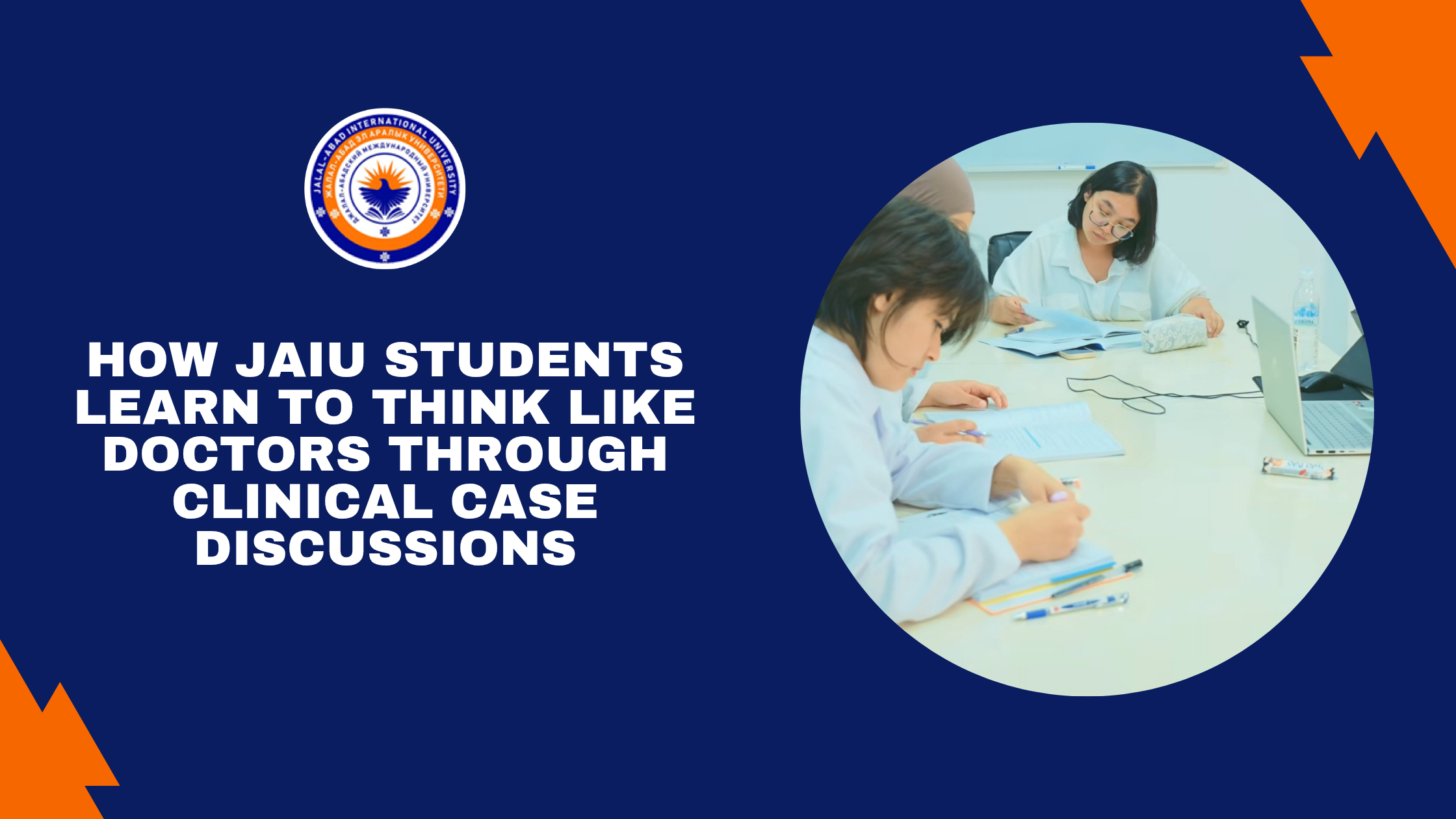
At Jalal-Abad International University (JAIU), clinical case discussions are part of the practice-oriented approach used to help medical students connect theoretical knowledge with real clinical situations. The university's Department of Clinical Disciplines specifically highlights clinical case discussions, simulation training, bedside teaching, and scientific discussions as interactive teaching methods designed to develop clinical thinking and communication skills.
A clinical case discussion starts with a patient situation rather than a simple textbook question.
Students may be given information about a patient's symptoms, medical history, examination findings, or investigation results. Instead of immediately being given the diagnosis, they are encouraged to analyse the information and discuss what it could mean.
The process can involve questions such as:
This approach encourages students to think through a medical problem rather than simply recall an answer.
One of the challenges in medical education is understanding how basic science connects with actual patient care.
A student may study anatomy, physiology, microbiology, pathology, or pharmacology as separate subjects. Clinical case discussions can help bring those areas together.
For example, understanding the mechanism of a disease becomes more meaningful when students consider how that disease could affect a patient's symptoms, examination findings, laboratory results, and treatment options.
JAIU's Department of Clinical Disciplines describes its educational approach as practice-oriented and based on evidence-based medicine, with an emphasis on analysing clinical information and developing clinical thinking.
Clinical reasoning begins with asking useful questions.
When presented with a patient case, students need to determine which information matters most. A patient's age, symptoms, medical history, medications, lifestyle, examination findings, and investigation results may all contribute to understanding the situation.
Case discussions give students an opportunity to practise identifying relevant information.
Instead of asking only, “What is the diagnosis?”, students can learn to ask, “What evidence supports this possibility?” and “What other possibilities should be considered?”
That shift from memorising answers to analysing evidence is an important part of developing clinical reasoning.
Doctors often need to consider more than one possible explanation for a patient's symptoms.
This is where differential diagnosis becomes important. Students learn to compare possible conditions and determine which findings support or argue against each possibility.
Clinical case discussions can provide a structured environment for practising this process.
Students may discuss why one diagnosis appears more likely, what information is missing, and what investigation could help distinguish between different possibilities.
The goal is not simply to reach an answer quickly. It is to understand the reasoning that leads to that answer.
Modern medical practice requires doctors to make decisions based on reliable evidence while considering the individual patient.
JAIU's Department of Clinical Disciplines states that its educational process is based on evidence-based medicine principles and includes analysis of modern international clinical recommendations and their adaptation to healthcare conditions in Kyrgyzstan.
This approach can help students understand that medical decisions should not be based only on memory or personal assumptions.
When discussing a clinical case, students can learn to connect the patient's presentation with established medical knowledge, clinical recommendations, and appropriate diagnostic or treatment approaches.
Being able to reach a clinical conclusion is only one part of being a doctor.
Doctors also need to communicate with patients and healthcare professionals.
JAIU's Department of Clinical Disciplines places particular attention on communication with patients, medical ethics, and respectful patient management.
Case discussions can help students think about how they would explain a medical situation to a patient, what questions they should ask, and how they should communicate sensitive information.
This is especially important because clinical care involves people, not just diagnoses.
Clinical reasoning develops across different areas of medicine.
JAIU's Department of Clinical Disciplines covers areas including therapy, surgery, pediatrics, obstetrics and gynecology, anesthesiology and resuscitation, infectious diseases, neurology, and other clinical subjects. Students receive clinical training through specialized hospitals, children's hospitals, perinatal centres, outpatient institutions, and other clinical facilities.
Exposure to different specialties allows students to encounter different types of clinical problems.
A pediatric case may require a different approach from an adult surgical case. An emergency situation may require rapid prioritisation, while a chronic condition may require long-term management.
Working through varied cases helps students understand these differences.
Clinical case discussions are not meant to replace patient contact. Instead, they help prepare students to make better use of clinical exposure.
JAIU states that students begin clinical activities early, with clinical sessions from the second semester onward across areas including therapy, surgery, pediatrics, obstetrics and gynecology, psychiatry, emergency and urgent care.
The university's clinical training model combines theoretical preparation with work in real clinical environments.
During supervised practice, students may participate in patient consultations, collect medical histories, perform physical examinations, maintain medical documentation, and discuss diagnoses and management plans with supervisors. JAIU's educational programme documentation describes these activities as part of supervised clinical practice.
This creates a progression from discussing cases academically to encountering real patients under supervision.
Clinical reasoning also needs to be assessed.
JAIU uses competency-oriented assessment methods including OSCE, Mini-CEX, DOPS, and peer assessment, according to its Department of Clinical Disciplines.
These assessment methods can evaluate different aspects of medical competence, including practical performance, communication, clinical reasoning, and professional behaviour.
For students, this means that understanding a clinical topic is only one part of preparation. They also need to demonstrate how they apply their knowledge in practical situations.
Medical care is rarely delivered by one person working alone.
Doctors work with nurses, specialists, laboratory professionals, pharmacists, technicians, and other healthcare workers.
JAIU's Department of Clinical Disciplines describes regular interdisciplinary clinical discussions involving specialists such as therapists, surgeons, pediatricians, obstetrician-gynecologists, and anesthesiologists-resuscitators. The university states that these activities help develop multidisciplinary teamwork skills.
Discussing cases from different professional perspectives can help students understand how different specialists contribute to patient care.
No student becomes a confident clinical thinker after studying a few cases.
It is a gradual process.
Students begin by learning fundamental medical sciences. They then encounter clinical examples, discuss patient cases, practise skills, receive feedback, and gradually take on more responsibility during supervised clinical training.
JAIU's Simulation Center follows a similar progression, moving students from basic communication and patient-care skills toward diagnostic and therapeutic procedures, clinical case analysis, and supervised work in senior years.
The combination of case discussion, simulation, assessment, and clinical exposure provides multiple opportunities for students to develop their reasoning skills.
The ultimate purpose of clinical case discussions is not to produce students who can simply answer examination questions.
The objective is to help future doctors understand how to approach a patient problem logically and responsibly.
When students learn to collect information, analyse evidence, consider different possibilities, communicate effectively, and justify their decisions, they are developing skills that can remain relevant throughout their medical careers.
JAIU's current medical education approach combines clinical case discussions with early clinical exposure, simulation-based learning, evidence-based medicine, and competency-oriented assessment.
Learning medicine means learning how to think as well as what to remember.
At Jalal-Abad International University, clinical case discussions give students opportunities to connect medical theory with patient situations, analyse clinical information, consider different diagnoses, discuss evidence, and develop communication and teamwork skills.
Combined with simulation training and supervised clinical exposure, these discussions form part of a gradual pathway from classroom learning toward real medical practice.
For future doctors, the ability to think through a clinical problem carefully can be just as important as remembering the information in a textbook. Case-based learning gives students an opportunity to practise that process before they take on greater responsibilities in clinical environments.
All Blog Posts

 Happy World Teachers’ Day: Celebrating the Educators Who Shape the Future of Medicine
JAIU & Gen Z: Shaping the Future of Medical Education and Tomorrow’s Doctors
A New Journey Begins: JAIU Welcomes the Second Batch of Medical Students in Manas
JAIU in 2026: What the New Generation of Medical Students Really Wants
Jalal-Abad International University Participates in the Third Russian-Kyrgyz Educational Forum