Date: Sep 30, 2026 Day: Wednesday
Medical education is not only about learning established medical knowledge. Future doctors also need to understand how new medical knowledge is created, evaluated and applied. Research helps students develop the ability to ask meaningful questions, analyse evidence and understand healthcare problems from a scientific perspective.
At Jalal-Abad International University (JAIU), research is integrated into medical education as part of the broader learning process. The university's current academic framework focuses on developing research competencies, while its departments and student scientific activities provide opportunities for students to begin exploring research from the early years of medical education.
For many medical students, research can initially seem like something reserved for postgraduate students or experienced doctors. Early exposure can change that perception.
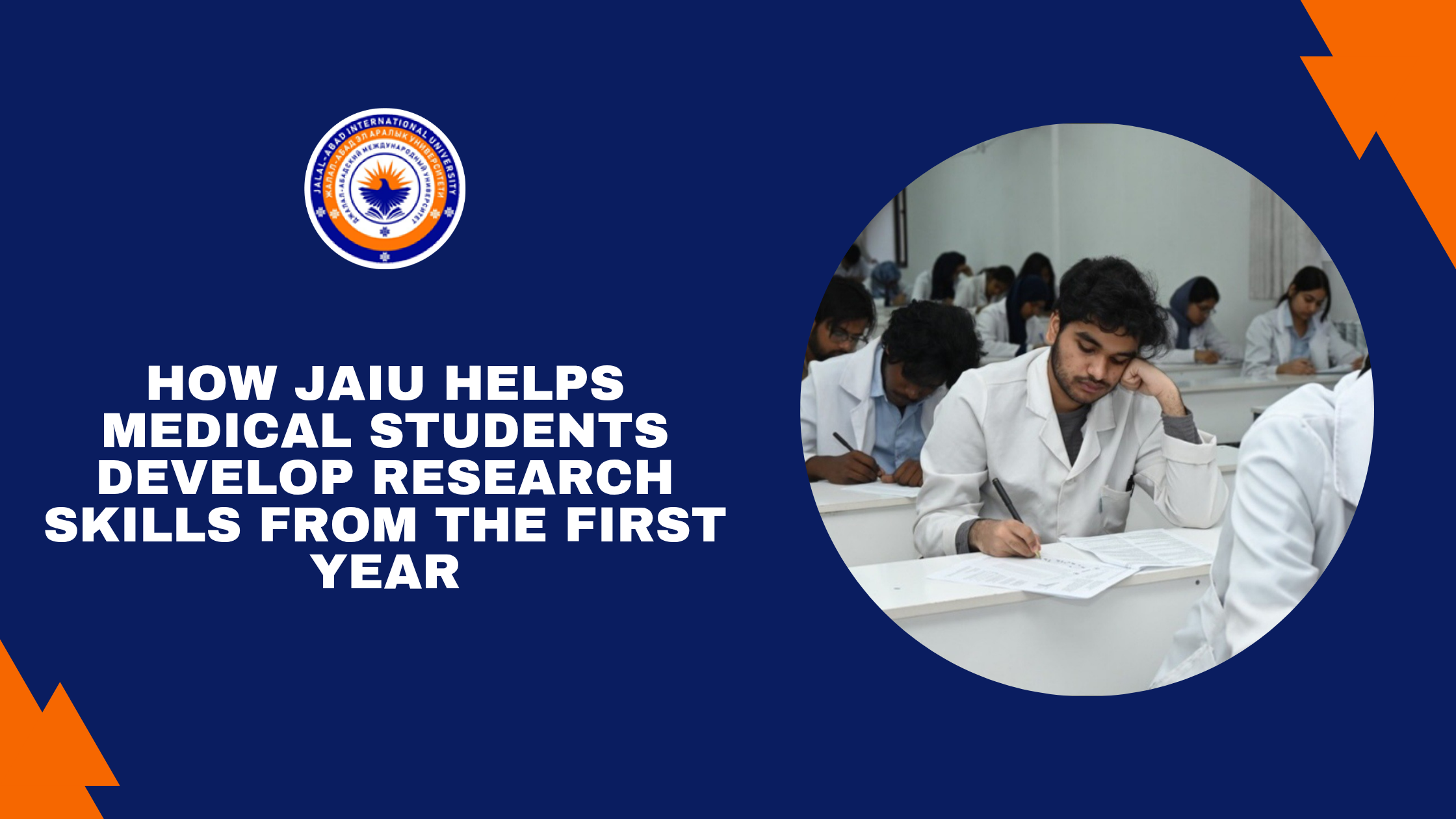
JAIU's Department of Morphological Disciplines specifically states that student research work is integrated with the educational process and that particular attention is given to developing research thinking and practical skills among students beginning from the first year. Students across different years can participate in scientific clubs, research projects and preparation of scientific papers.
This approach allows students to gradually become familiar with research rather than encountering it for the first time near graduation.
A strong research project begins with a meaningful question. Medical students need to learn how to identify a problem, understand what is already known and determine what information still needs investigation.
JAIU's research activities cover areas including morphology, public health, epidemiology and clinical research. These fields give medical students different directions in which they can explore healthcare-related questions.
By connecting research topics with subjects students are already studying, research can become an extension of classroom learning.
For example, a student studying anatomy may become interested in clinical anatomy or medical imaging, while a student studying public health may explore disease prevention or epidemiological patterns.
Research can be difficult for beginners because students may not know how to select a topic, organise information or evaluate scientific evidence.
JAIU has a mentoring system in which experienced teachers supervise student research projects. According to the university, this guidance helps students develop scientific analysis, critical thinking and academic writing skills.
Faculty supervision can therefore provide students with a structured way to learn research methodology. Instead of simply collecting information, students can learn how to approach a research problem systematically.
JAIU's FAQ also encourages students interested in research to connect with faculty supervisors from their first year.
Being able to conduct research is only part of the process. Students also need to communicate their findings clearly.
Academic writing teaches students how to structure an argument, use scientific terminology appropriately, reference sources and present evidence logically.
JAIU's Student Science activities include seminars and training related to academic writing and publication preparation. Students can receive support while developing their own research and preparing work for presentation or publication.
These skills can also be useful outside research. Medical students regularly need to interpret scientific literature, prepare academic assignments and communicate clinical information accurately.
Medical research often involves analysing data. Therefore, understanding basic research methodology and biostatistics can help students interpret scientific findings more effectively.
JAIU's research community activities include training related to research methodology and biostatistics. The university's Student Science initiatives are designed to help students understand the process of developing research projects and preparing scientific work.
For a medical student, these skills can make it easier to understand concepts such as study design, samples, variables, statistical findings and interpretation of research results.
One way JAIU provides a research environment is through student scientific clubs.
The university currently lists a student scientific club focused on Clinical Anatomy and Medical Imaging. Its activities include studying clinical anatomy, exploring medical imaging techniques such as CT, MRI and ultrasound, analysing clinical cases, participating in scientific seminars and developing research and scientific publication skills.
Such clubs can provide students with an environment where they can work with peers who have similar academic interests.
They also create opportunities to practise teamwork, communication and presentation skills alongside research activities.
Research becomes more valuable when students have opportunities to share what they have learned.
JAIU regularly organises scientific events, including conferences, seminars, competitions and other academic activities where students and young researchers can present their work. The university also states that students can participate in research competitions, Science Days and idea fairs.
JAIU has also participated in broader scientific events. For example, its 2025 Eurasian Multidisciplinary Conference included a dedicated student research section in medicine.
Presenting research can help students learn how to explain scientific information clearly and respond to questions from an academic audience.
Publishing research is another part of academic development. While publication should not be treated as the only measure of research ability, learning how scientific papers are prepared can be valuable for students interested in academic medicine.
JAIU reports that students receive support in developing research, publishing articles and presenting their work at scientific forums. The university also maintains a research journal and lists student scientific publications among its research activities.
The university's published student research includes work on topics connected with medical education and clinical learning. One listed example is a 2025 paper on early clinical exposure for first-year medical students at JAIU.
Research skills are particularly important for medical students because healthcare continuously changes.
New diagnostic methods, treatments, technologies and approaches to disease prevention are developed through scientific investigation. Doctors therefore need to be able to evaluate evidence throughout their careers.
JAIU's Basic Educational Program connects scientific research with clinical practice and identifies research activity as one of its educational goals. It aims to develop students' motivation to conduct scientific work addressing current healthcare challenges.
This connection helps students understand that research is not separate from medicine. It can contribute to better understanding of diseases, healthcare systems and patient care.
Research can also introduce medical students to the wider academic community.
JAIU's research activities include cooperation with scientific centres and universities in Kyrgyzstan and other countries. The university also encourages participation in conferences, seminars and international academic activities.
For international medical students, exposure to different academic perspectives can broaden their understanding of healthcare beyond a single country or healthcare system.
Perhaps one of the most important benefits of early research exposure is the development of critical thinking.
Medical students encounter a huge amount of information during their education. Research training can teach them not to accept every claim automatically, but to ask where the information came from, what evidence supports it and whether the evidence is strong enough to support a particular conclusion.
This way of thinking is relevant both inside and outside the research environment.
JAIU's quality policy specifically identifies research and critical-analysis skills among the competencies it aims to develop through a student-centred and competency-based educational approach.
Students themselves play an important role in developing research skills.
A first-year medical student does not need to begin with a large or complicated research project. Starting with a scientific club, attending seminars, speaking with faculty members, learning basic research methodology and reading medical literature can provide a strong foundation.
Students can gradually progress toward developing research questions, participating in projects, preparing scientific papers and presenting their findings.
The key is consistency. Research skills develop over time through repeated practice and feedback.
Research can be an important part of becoming a modern medical professional. It teaches students how to ask questions, evaluate evidence, analyse information and communicate scientific findings.
At JAIU, students can begin developing these abilities from the early years of medical education through faculty mentorship, student scientific clubs, research projects, academic writing activities, conferences and publication opportunities. The university's current academic framework also places research competency alongside clinical and professional development.
For a medical student, starting research early does not necessarily mean becoming a full-time researcher. Instead, it means developing a scientific mindset that can support better learning, evidence-based thinking and continuous professional development throughout a medical career.
All Blog Posts

 Happy World Teachers’ Day: Celebrating the Educators Who Shape the Future of Medicine
JAIU & Gen Z: Shaping the Future of Medical Education and Tomorrow’s Doctors
A New Journey Begins: JAIU Welcomes the Second Batch of Medical Students in Manas
JAIU in 2026: What the New Generation of Medical Students Really Wants
Jalal-Abad International University Participates in the Third Russian-Kyrgyz Educational Forum