Date: Sep 27, 2026 Day: Sunday
Medical education is becoming increasingly international. Today, future doctors may study in one country, complete clinical training in another, attend international conferences, collaborate on research projects with students from different countries, and eventually build their careers in a healthcare system outside their home country.
For medical students, this changing environment makes international exposure an important part of education. Understanding different healthcare systems, communicating with people from different backgrounds, and learning how medical professionals approach healthcare challenges in different settings can help students develop a broader perspective.
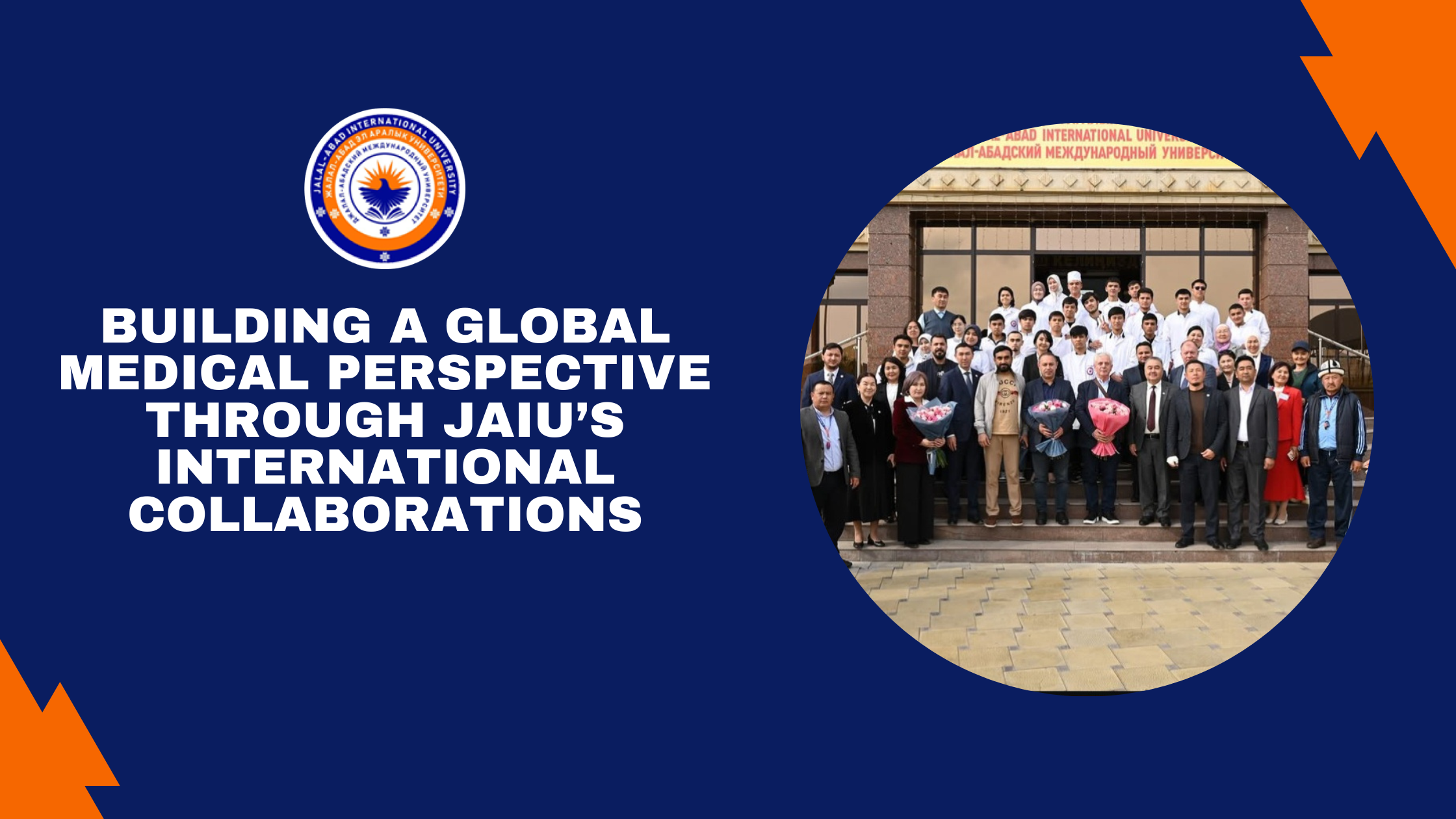
At Jalal-Abad International University (JAIU), international collaboration is becoming an important part of the university's medical education environment. The Medical Faculty has developed cooperation with medical universities and clinics in countries including Uzbekistan, India and Pakistan, with opportunities connected to academic mobility, internships and scientific conferences.
A global medical perspective means understanding that healthcare is not limited to one country or one healthcare system.
Diseases, treatment methods, medical technologies and healthcare challenges can be different across regions. At the same time, many health problems are shared internationally.
A medical student with international exposure can learn to look at healthcare from multiple perspectives. This may involve understanding differences in clinical practice, healthcare delivery, medical education, research and patient communication.
For students preparing for an international medical career, this broader perspective can complement their academic and clinical education.
JAIU's Office of International Relations serves as a link between the university and institutions around the world. According to the university, the office works with universities, hospitals, research institutions and educational organisations across regions including Central Asia, South Asia, the Middle East and Europe.
The university also describes a multicultural student community representing more than ten nationalities.
For a medical student, studying alongside people from different countries can itself become a form of international learning. Students can encounter different languages, cultures, educational backgrounds and perspectives while sharing the same academic environment.
This can help students become more comfortable communicating across cultural boundaries.
JAIU's Medical Faculty states that it has established cooperation with medical universities and clinics in Uzbekistan, India, Pakistan and other countries. These relationships are intended to support academic mobility, internships and participation in scientific conferences.
Such partnerships can create possibilities for students and faculty to interact with professionals outside their immediate academic environment.
International collaboration can also encourage the exchange of ideas about medical education, clinical practice and research.
The purpose is not simply to add international names to a university's network. Meaningful collaboration can provide opportunities for knowledge exchange and exposure to different academic and healthcare environments.
Academic mobility allows students to spend a period of their education at another institution or participate in an academic programme outside their usual campus.
JAIU's academic mobility regulations include exchange programmes, internships, educational and research practice, language and scientific internships, summer schools, conferences, seminars, competitions and joint projects among the forms of student mobility.
For medical students, these opportunities can add another dimension to their education.
A student who participates in an international programme may encounter different teaching methods, healthcare environments, professional practices and academic expectations.
The experience can also encourage students to become more independent and adaptable.
Clinical education is an important part of medical training. Seeing how healthcare is delivered in different environments can help students understand that clinical practice is influenced by local healthcare systems, resources, patient populations and professional structures.
JAIU's current clinical information states that the university is developing international clinical partnerships, including agreements with the CHINOR Medical Center of Tashkent Medical Academy and multidisciplinary clinics in India and Pakistan. The university says these relationships are intended to create opportunities for international internships and expand students' clinical experience.
Such exposure can complement the clinical training students receive in Kyrgyzstan.
It can also encourage students to compare different approaches while maintaining a focus on evidence-based medical practice.
International collaboration is not limited to student travel.
Universities can also invite medical professionals and academics from other countries to participate in lectures, discussions, training programmes and academic events.
For example, JAIU hosted Professor Dr. Rajiv Dhawan from India for a one-week academic lecture series in January 2026. The programme included discussions around medical education, curriculum development, clinical competence and preparation for Indian licensing examinations.
Interactions with visiting academics can expose students to professional perspectives that complement their regular classroom education.
They also provide opportunities for students to ask questions and understand how medical education and professional expectations are viewed in other settings.
Modern medicine depends heavily on research.
New diagnostic methods, treatments, technologies and public-health approaches are developed through scientific investigation and collaboration.
JAIU's international-relations framework includes support for international research collaboration, joint projects and academic publications. The university also identifies participation in international grants and research networks as part of its international engagement.
For students, exposure to research can encourage them to think beyond textbook knowledge.
They can learn how medical questions are developed, how evidence is evaluated, how research findings are communicated and why collaboration between institutions can be important in advancing healthcare knowledge.
JAIU has also continued expanding its international academic network.
In March 2026, the university announced Memoranda of Understanding with John F. Kennedy University School of Medicine and Caribbean Medical University in Curaçao. The announced areas of cooperation included joint research, academic events, faculty exchange, student and young-doctor mobility, and participation in research programmes.
JAIU also signed an MoU with the University of Khorfakkan in the United Arab Emirates covering areas such as medical education, medical science, healthcare, faculty exchange, student mobility and joint academic research.
These examples illustrate how international cooperation can extend beyond a single region.
A doctor does not treat diseases in isolation. Doctors work with people who may have different languages, cultural backgrounds, beliefs and expectations.
International students can therefore benefit from learning how to communicate respectfully across cultures.
JAIU's academic programme specifically includes support for international students' linguistic, sociocultural and academic adaptation, as well as communication skills and professional ethics.
This is particularly relevant in a university with students from multiple countries.
Learning alongside international classmates can help students become more comfortable asking questions, explaining ideas and working as part of diverse teams.
Students who plan to work internationally need more than a medical degree. They may eventually need to meet the licensing, registration and professional requirements of the country where they want to practise.
International exposure during medical school cannot replace those requirements, but it can help students understand that medical practice exists within different professional and regulatory environments.
JAIU's international-relations office describes its role as supporting academic mobility, international partnerships and professional connections, while the university's career and licensing resources provide pathways related to examinations such as FMGE/NExT, PLAB and USMLE.
Students should still verify current licensing rules directly with the relevant medical regulator for their intended country.
International education is not only about travelling to another country.
It can begin with asking how a healthcare problem is managed elsewhere, discussing medical cases with students from different backgrounds, attending an international conference, participating in research, or listening to a visiting specialist.
These experiences can encourage students to remain curious and open to different approaches while continuing to evaluate medical information critically.
For future doctors, that mindset can be valuable throughout their careers.
JAIU's international collaborations are part of a broader effort to connect education, clinical practice, research and academic mobility.
The university's Medical Faculty describes its international relationships as a way to provide students with opportunities for exchange programmes, internships and scientific conferences.
Its academic mobility framework further provides a formal structure for exchange, internships, research activities, conferences and joint projects.
Together, these initiatives can give students opportunities to look beyond a single classroom or healthcare system.
A modern medical career can cross borders. As healthcare becomes increasingly connected through research, technology, education and professional collaboration, medical students can benefit from understanding healthcare from more than one perspective.
At Jalal-Abad International University, international collaborations provide a framework for academic mobility, clinical exposure, research, conferences and interaction with medical professionals from different countries.
For students, these experiences can contribute to a broader understanding of medicine and encourage them to develop the adaptability, communication skills and curiosity needed in an increasingly interconnected healthcare environment.
A global medical perspective does not mean leaving behind the fundamentals of medicine. It means learning those fundamentals while understanding how they connect to patients, professionals, research and healthcare systems around the world.
All Blog Posts

 Happy World Teachers’ Day: Celebrating the Educators Who Shape the Future of Medicine
JAIU & Gen Z: Shaping the Future of Medical Education and Tomorrow’s Doctors
A New Journey Begins: JAIU Welcomes the Second Batch of Medical Students in Manas
JAIU in 2026: What the New Generation of Medical Students Really Wants
Jalal-Abad International University Participates in the Third Russian-Kyrgyz Educational Forum